
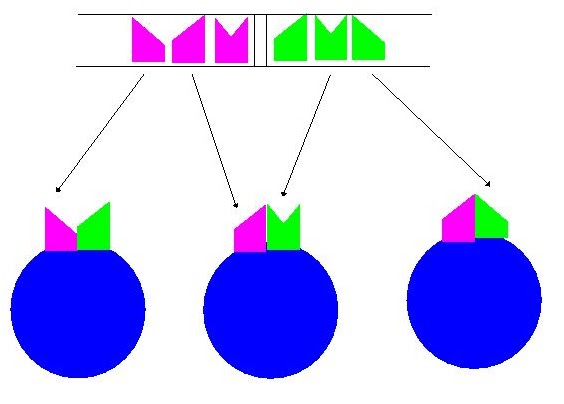
Pharmacodynamics describes the actions
of a drug on the body and the influence of drug concentrations on the magnitude
of the response. Most drugs exert their effects, both beneficial and harmful,
by interacting with receptors (that is, specialized target macromolecules)
present on the cell surface or within the cell. The drug–receptor complex
initiates alterations in biochemical and/or molecular activity of a cell by a
process called signal transduction. There are two types of drugs actions.
1-
Drug
action mediated by the receptor.
2-
Drug
action not mediated by the receptor.
1.
DRUG ACTION MEDIATED BY THE RECEPTORS
The drug–receptor
complex: Cells have
different types of receptors, each of which is specific for a particular ligand and produces a unique response. The heart, for example, contains membrane receptors
that bind and respond to epinephrine or
norepinephrine as well as muscarinic receptors specific for acetylcholine. These receptors dynamically interact to control
the hearts vital functions. The
magnitude of the response is proportional
to the number of drug–receptor complexes:
Drug + Receptor àDrug–receptor
complex àBiologic
effect
Major receptor families
Pharmacology
defines a receptor as any biologic molecule to which a drug binds and produces
a measurable response. Thus, enzymes, nucleic acids, and structural proteins
can be considered to be pharmacologic receptors. However, the richest sources
of therapeutically exploitable pharmacologic receptors are proteins that are
responsible for transducing extracellular signals into intracellular responses.
a.
Transmembrane ligand-gated ion
channels: The first
receptor family comprises ligand-gated ion channels that are responsible for
regulation of the flow of ions across cell membranes. The activity of these
channels is regulated by the binding of a ligand to the channel. Response to
these receptors is very rapid, enduring for only a few milliseconds. These
receptors mediate diverse functions, including neurotransmission, cardiac
conduction, and muscle contraction.
b.
Transmembrane G protein–coupled
receptors: A second
family of receptors consists of G protein–coupled receptors. These receptors
comprise a single helical peptide that has seven membrane spanning regions. The
extracellular domain of this receptor usually contains the ligand-binding area
(a few ligands interact within the receptor transmembrane domain). Intracellularly,
these receptors are linked to a G protein (Gs, Gi, and others) having three
subunits, an alpha subunit that binds guanosine triphosphate (GTP), and a beta
and a gamma subunits. Binding of the appropriate ligand to the extracellular
region of the receptor activates the G protein so that GTP replaces guanosine
diphosphate (GDP) on the α subunit. Dissociation of the G protein occurs, and
both the α-GTP subunit and the β subunit subsequently interact with other
cellular effectors, usually an enzyme, a protein, or an ion channel. These
effectors then activate second messengers that are responsible for further
actions within the cell.
c.
Enzyme-linked receptors:
A third major family
of receptors consists of a protein that spans the membrane once and may form dimmers
or multi subunit complexes. These receptors also have cytosolic enzyme activity
as an integral component of their structure and function. Binding of a ligand
to an extracellular domain activates or inhibits this cytosolic enzyme
activity. Duration of responses to stimulation of these receptors is on the
order of minutes to hours. Metabolism, growth, and differentiation are
important biological functions controlled by these types of receptors. The most
common enzyme-linked receptors (epidermal growth factor, platelet-derived
growth factor, atrial natriuretic peptide, insulin, and others) are those that
have a tyrosine kinase activity as part of their structure. Typically, upon
binding of the ligand to receptor subunits, the receptor undergoes
conformational changes, converting kinases from their inactive forms to active
forms. The activated receptor autophosphorylates and then phosphorylates
tyrosine residues on specific proteins. The addition of a phosphate group can
substantially modify the three-dimensional structure of the target protein,
thereby acting as a molecular switch.
d.
Intracellular receptors:
The fourth family of
receptors differs considerably from the other three in that the receptor is
entirely intracellular, and, therefore, the ligand must diffuse into the cell
to interact with the receptor. This places constraints on the physical and chemical
properties of the ligand, because it must have sufficient lipid solubility to
be able to move across the target cell membrane. Because these receptor ligands
are lipid soluble, they are transported in the body attached to plasma proteins
such as albumin. The primary targets of these ligand-receptor complexes are
transcription factors. The activation or inactivation of these factors causes
the transcription of DNA into RNA and translation of RNA into an array of
proteins.
2.
AGONIST
An agonist binds to a receptor and
produces a biologic response. An agonist may mimic the response of the
endogenous ligand on the receptor, or it may elicit a different response from
the receptor and its transduction mechanism.
o Full
agonists: If a drug
binds to a receptor and produces a maximal biologic response
that mimics the
response to the endogenous ligand, it is known as a
full agonist.
o Partial
agonists: Partial
agonists have efficacies (intrinsic activities) greater than zero but less than
that of a full agonist.
o Inverse
agonist:
Inverse agonists, unlike
full agonists, stabilize the inactive receptor (R not R*) form.
3.
ANTAGONIST
Antagonists
are drugs that decrease or oppose the actions of another drug or endogenous
ligand.
Competitive antagonists:
If both the
antagonist and the agonist bind to the same site on the receptor, they are said
to be “competitive.” The competitive antagonist will prevent an agonist from
binding to its receptor and maintain the receptor in its inactive
conformational state.
Irreversible antagonists:
An irreversible
antagonist causes a downward shift of the maximum, with no shift of the curve
on the dose axis unless spare receptors are present. The effects of competitive
antagonists can be overcome by adding more agonist. Irreversible antagonists,
by contrast, cannot be overcome by adding more agonist.
Functional and chemical
antagonism: An
antagonist may act at a completely separate receptor, initiating effects that
are functionally opposite those of the agonist.
4.
DRUG ACTION NOT
MEDIATED BY THE RECEPTOR
The
followings are the some specific examples of the drugs whose action are not
mediated by the receptors
o Enzymes
o Metabolic analogues (antimetabolite)
o Chelation of metallic ions
o Microcrystal formation
o Uncoupling of energy mechanism
o Biochemical and biophysical properties
of drugs.
Enzyme: Drugs influencing various enzyme
systems, the anti-cholinesterase’s like neostigmine and organic phosphorus
insecticide ---inhibition of cholinesterase, monoamine oxidase (MAO) inhibitors
like phenelzine--- inhibit oxidation of, epinephrine and nor-epinephrine.
Metabolic analogues
(antimetabolite): These
are usually closely related
chemically to the substrate. For example sulphonamides --- antimetabolites of
para aminobenzoic acid (PABA). PABA is
an intermediate in the bacterial synthesis of folate, are structurally similar
to PABA, and their antibacterial activity is due to their ability to interfere
with the conversion of PABA to folate by the enzyme dihydropteroate synthetase.
Thus, bacterial growth is limited through folate deficiency without effect on
human cells.
Chelation of metallic
ions: Drugs may
chelate a metallic ion needed for the normal functioning of an enzyme system.
In this way, a parasitic microorganism might be destroyed. The metal ions in
chelate form may become fat-soluble and hence penetrate to tissues where they
would not normally reach. The toxicity
of antibacterial drugs like 8-hydroxyquoinoline oxime depends on the formation
of a copper-oxime complex. Some drugs form readily metal chelates e.g. lead,
antimony, copper and arsenic.
Microcrystal formation: Some drugs may form microcrystals with
water or other cellular substance which can then affect cellular function.
Uncoupling of energy
mechanism: Some drugs
effect the intracellular energy relationships of the adenosine phosphate and
the regeneration of adenosine triphosphate (ATP) by intracellular oxidative
processes without interaction with receptors. Failure of ATP could result in
reduction of cessation of certain energy linked reactions. For example narcotic
effect of barbiturates—uncoupling of oxidative phosphorylation.
Biochemical and
biophysical properties of drugs:
These drugs influence any of the
steps involved in the maintenance of normal cellular functions, enhance or
prevent the entrance of substances into the cell. Transport of glucose into
cells is enhanced by insulin permeability of the neuromuscular junction to ions
is increased by acetylcholine


